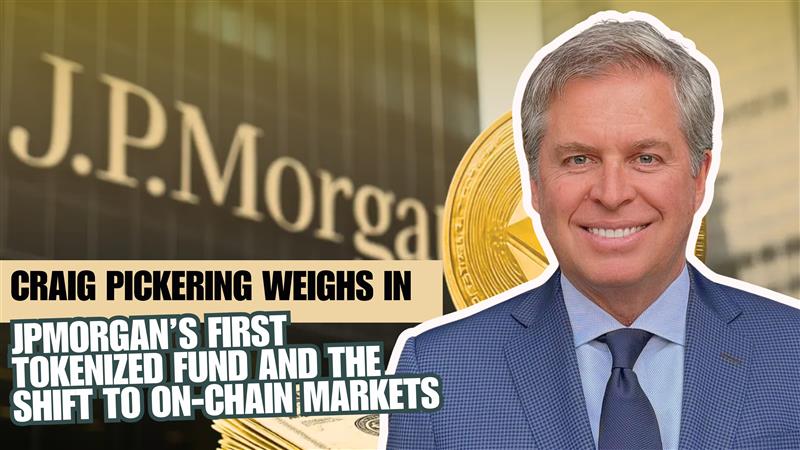
I’ve been watching the intersection of finance and technology for a long time, and JPMorgan’s recent launch of its first tokenized money market fund on the Ethereum blockchain felt different from a typical product announcement. To me, it marked a clear signal that blockchain is no longer something traditional finance can afford to observe from a distance.
This is the same institution led by Jamie Dimon, who was once openly hostile toward Bitcoin and crypto trading. Now JPMorgan is actively putting real financial products on-chain. At the same time, the SEC chairman has publicly stated that U.S. financial markets are “poised to move on chain.” That combination matters. It tells me this shift isn’t theoretical or years away. It’s already underway.
At its core, tokenization is about representing real-world assets as digital tokens on a blockchain. In this case, a money market fund. That means ownership, settlement, and transfers can happen with greater speed, transparency, and automation than traditional systems allow. What used to take days can happen nearly instantly. What once required multiple intermediaries can be streamlined.
From my perspective at Cirrus Networks and Gnodi, this moment is more confirmation than surprise.
“At our company, we’ve said for a long time that we believe almost all assets will be tokenized in the future,” I often explain. “Initially, the tokenization that will happen will be with financial products. Stocks, funds, exchanges, and crypto-related assets. This announcement just shows that it’s not coming someday. It’s here now.”
I’ve spent years working across infrastructure, connectivity, and emerging technology, and tokenization follows a familiar pattern. New technology is often dismissed early, tested quietly, and then adopted quickly once large institutions commit.
Financial products are the natural starting point. They’re already digital in many ways, governed by rules, and dependent on settlement systems that are overdue for improvement. Tokenization allows those systems to operate more efficiently while still fitting within regulatory frameworks.
What makes JPMorgan’s move especially important, in my view, is credibility. When a global bank with deep regulatory ties puts real capital and real products on-chain, it lowers the barrier for others to follow. Asset managers, exchanges, and institutional investors can no longer treat blockchain as experimental. It becomes infrastructure.
I also think it’s important to point out that this shift doesn’t require people to care about crypto culture or speculation.
“This isn’t about hype or price movement,” I say often. “It’s about how assets are issued, tracked, settled, and moved. Blockchain just happens to be a better rail for that.”
As more assets become tokenized, the implications go well beyond finance. Real estate, private equity, commodities, and even intellectual property can follow the same model. Tokenization makes ownership more flexible and programmable. It opens the door to fractional ownership, faster liquidity, and global access without rebuilding systems from scratch.
At the same time, I’m realistic about the pace.
“This doesn’t mean everything changes overnight,” I note. “There are regulatory, technical, and operational steps that still need to happen. But the direction is clear.”
JPMorgan’s tokenized fund is one of those steps. Not flashy. Not experimental. Just functional. And that may be exactly what makes it most significant.
For me, the takeaway is simple: the conversation has moved on from whether tokenization will happen to how fast it will scale.
“It’s no longer a future belief,” I say. “It’s a present reality.”
And for financial markets, that reality is already taking shape on-chain.